Anf the Laeks Sang Once Again Ij Somme Poem
| I Wandered Lonely as a Deject | |
|---|---|
| past William Wordsworth | |
 A mitt-written manuscript of the verse form (1802). British Library Add. MS 47864[1] | |
| Read online | I Wandered Lonely as a Deject at Wikisource |
I wandered lonely as a cloud
That floats on high o'er vales and hills,
When all at once I saw a crowd,
A host, of gilded daffodils;
Beside the lake, beneath the trees,
Fluttering and dancing in the breeze.Continuous as the stars that smoothen
And twinkle on the milky way,
They stretched in never-ending line
Along the margin of a bay:
Ten thousand saw I at a glance,
Tossing their heads in sprightly dance.The waves beside them danced; but they
Out-did the sparkling waves in glee:
A poet could not just exist gay,
In such a jocund visitor:
I gazed—and gazed—only petty thought
What wealth the bear witness to me had brought:For ofttimes, when on my burrow I prevarication
In vacant or in pensive mood,
They flash upon that inwards centre
Which is the bliss of confinement;
And and so my heart with pleasure fills,
And dances with the daffodils.
– William Wordsworth (1802)
"I Wandered Lonely as a Cloud" (also commonly known as "Daffodils"[ii]) is a lyric verse form by William Wordsworth.[3] It is ane of the virtually pop poems of Wordsworth. The poem was inspired by an event on 15 April 1802 in which Wordsworth and his sister Dorothy came across a "long belt" of daffodils while wandering in the forest.[4] Written some time between 1804 and 1807 (in 1804 by Wordsworth's own account),[5] it was first published in 1807 in Poems, in Two Volumes, and a revised version was published in 1815.[half dozen]
In a poll conducted in 1995 past the BBC Radio iv Bookworm programme to decide the nation's favourite poems, I Wandered Alone as a Cloud came fifth.[vii] Ofttimes anthologised, the poem is ordinarily seen every bit a classic of English Romantic poetry, although Poems, in Ii Volumes, in which it get-go appeared, was poorly reviewed by Wordsworth's contemporaries.
Groundwork [edit]
The inspiration for the poem came from a walk Wordsworth took with his sister Dorothy around Glencoyne Bay, Ullswater, in the Lake District.[8] [4] He would draw on this to compose "I Wandered Lonely every bit a Cloud" in 1804, inspired by Dorothy's journal entry describing the walk near a lake at Grasmere in England:[eight]
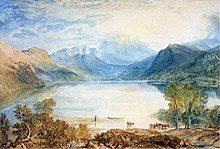
When we were in the woods beyond Gowbarrow park we saw a few daffodils close to the water side, nosotros fancied that the lake had floated the seed ashore and that the little colony had and so sprung up – But as we went forth there were more and yet more and at last under the boughs of the trees, we saw that there was a long belt of them along the shore, about the breadth of a country turnpike road. I never saw daffodils and then beautiful they grew among the mossy stones nigh and near them, some rested their heads upon these stones as on a pillow for weariness and the rest tossed and reeled and danced and seemed as if they verily laughed with the air current that blew upon them over the Lake, they looked so gay ever glancing e'er irresolute. This wind blew directly over the lake to them. There was here and in that location a fiddling knot and a few stragglers a few yards higher up but they were and then few as not to disturb the simplicity and unity and life of that one busy highway – We rested again and again. The Trophy were stormy and we heard the waves at different distances and in the middle of the h2o like the Ocean.[9]
—Dorothy Wordsworth, The Grasmere Journal Thursday, xv April 1802
At the time he wrote the verse form, Wordsworth was living with his married woman, Mary Hutchinson, and sister Dorothy at Boondocks End,[Annotation 1] in Grasmere in the Lake District.[ten] Mary contributed what Wordsworth later said were the two all-time lines in the poem, recalling the "tranquil restoration" of Tintern Abbey,[Note 2]
- "They flash upon that inward middle
- Which is the bliss of solitude"
Wordsworth was aware of the appropriateness of the idea of daffodils which "wink upon that inward center" because in his 1815 version he added a note commenting on the "flash" as an "ocular spectrum". Coleridge in Biographia Literaria of 1817, while acknowledging the concept of "visual spectrum" equally being "well known", described Wordsworth'southward (and Mary's) lines, amidst others, as "mental bombast". Fred Blick[11] has shown that the idea of flashing flowers was derived from the "Elizabeth Linnaeus miracle", so called because of the discovery of flashing flowers past Elizabeth Linnaeus in 1762. Wordsworth described it every bit "rather an elementary feeling and simple impression (approaching to the nature of an ocular spectrum) upon the imaginative kinesthesia, rather than an exertion of information technology..."[12] The phenomenon was reported upon in 1789 and 1794 by Erasmus Darwin, whose work Wordsworth certainly read.
The entire household thus contributed to the poem.[5] Notwithstanding, Wordsworth's biographer Mary Moorman notes that Dorothy was excluded from the poem, even though she had seen the daffodils together with Wordsworth. The poem itself was placed in a department of Poems in Two Volumes entitled "Moods of my Mind" in which he grouped together his most deeply felt lyrics. Others included "To a Butterfly", a childhood recollection of chasing butterflies with Dorothy, and "The Sparrow's Nest", in which he says of Dorothy "She gave me eyes, she gave me ears".[thirteen]
The earlier Lyrical Ballads, a collection of poems by both Wordsworth and Samuel Taylor Coleridge, had been showtime published in 1798 and had started the romantic movement in England. It had brought Wordsworth and the other Lake poets into the poetic limelight. Wordsworth had published nix new since the 1800 edition of Lyrical Ballads, and a new publication was eagerly awaited.[14] Wordsworth had, even so, gained some financial security past the 1805 publication of the fourth edition of Lyrical Ballads; it was the first from which he enjoyed the profits of copyright buying. He decided to plough abroad from the long poem he was working on (The Recluse) and devote more attention to publishing Poems in Two Volumes, in which "I Wandered Lonely every bit a Cloud" showtime appeared.[15]
Revised version [edit]

Wordsworth revised the poem in 1815. He replaced "dancing" with "gilded"; "along" with "beside"; and "x thousand" with "fluttering and". He and so added a stanza betwixt the first and 2d, and changed "laughing" to "jocund". The last stanza was left untouched.[16]
I wandered alone as a cloud
That floats on high o'er vales and hills,
When all at once I saw a oversupply,
A host of gold daffodils;
Beside the lake, beneath the copse,
Fluttering and dancing in the cakewalk.Continuous equally the stars that polish
and twinkle on the Milky Style,
They stretched in never-ending line
along the margin of a bay:
X k saw I at a glance,
tossing their heads in sprightly trip the light fantastic.The waves abreast them danced; only they
Out-did the sparkling waves in glee:
A poet could not simply be gay,
in such a jocund company:
I gazed—and gazed—merely piffling thought
what wealth the show to me had brought:For often, when on my couch I prevarication
In vacant or in pensive mood,
They wink upon that inwards center
Which is the bliss of solitude;
And and so my eye with pleasure fills,
And dances with the daffodils.
Pamela Wolfe wrote that "The permanence of stars as compared with flowers emphasises the permanence of memory for the poet."[17] Andrew Motion, in a piece about the enduring appeal of the poem, wrote that "the final verse … replicates in the minds of its readers the very feel information technology describes".[12]
Reception [edit]
Contemporary [edit]
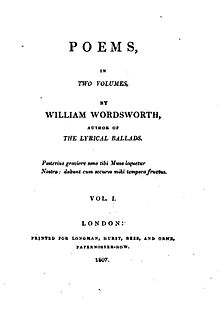
Poems, in Two Volumes was poorly reviewed past Wordsworth'south contemporaries, including Lord Byron, whom Wordsworth came to despise.[eighteen] Byron said of the volume, in one of its get-go reviews, "Mr. [Wordsworth] ceases to please, ... clothing [his ideas] in language not simple, merely puerile".[19] Wordsworth himself wrote ahead to soften the thoughts of The Disquisitional Review, hoping his friend Francis Wrangham would push for a softer approach. He succeeded in preventing a known enemy from writing the review, but it did not help; every bit Wordsworth himself said, it was a case of, "Out of the frying pan, into the burn down". Of any positives within Poems, in Ii Volumes, the perceived masculinity in "The Happy Warrior", written on the death of Nelson and unlikely to exist the subject of attack, was one such. Poems like "I Wandered Lonely as a Deject" could not have been farther from it. Wordsworth took the reviews stoically.[fourteen]
Even Wordsworth's shut friend Coleridge said (referring especially to the "child-philosopher" stanzas Seven and Eight of "Intimations of Immortality") that the poems contained "mental bombast".[twenty] 2 years later, however, many were more positive well-nigh the collection. Samuel Rogers said that he had "dwelt particularly on the cute idea of the 'Dancing Daffodils'", and this was echoed by Henry Crabb Robinson. Critics were rebutted by public opinion, and the piece of work gained in popularity and recognition, every bit did Wordsworth.[12]
Poems, in Two Volumes was savagely reviewed by Francis Jeffrey in the Edinburgh Review (without, all the same, singling out "I wandered lonely as a Cloud"), but the Review was well known for its dislike of the Lake Poets. Every bit Sir Walter Scott put it at the time of the poem's publication, "Wordsworth is harshly treated in the Edinburgh Review, but Jeffrey gives ... as much praise equally he usually does", and indeed Jeffrey praised the sonnets.[21]
Upon the author's death in 1850, The Westminster Review called "I wandered lonely as a Cloud" "very exquisite".[22]
Settings to music [edit]
The poem has been set to music, for example past Eric Thiman. In 2007, Cumbria Tourism released a rap version of the poem, featuring MC Nuts, a Lake District red squirrel, in an endeavour to capture the "YouTube generation" and attract tourists to the Lake District. Published on the two-hundredth anniversary of the original, information technology attracted wide media attention.[23] Information technology was welcomed past the Wordsworth Trust,[24] but attracted the disapproval of some commentators.[25]
Mod usage [edit]
The poem is presented and taught in many schools in the English language-speaking world.
United kingdom of great britain and northern ireland [edit]
These include the English language Literature GCSE course in some examination boards in England, Wales, and Northern Ireland. In 2004, in celebration of the 200th anniversary of the writing of the poem, information technology was read aloud by 150,000 British schoolchildren, aimed both at improving recognition of poetry and supporting Marie Curie Cancer Care (which uses the daffodil as a symbol, for example in the Swell Daffodil Appeal).[26]
Abroad [edit]
It is used in the current Higher School Certificate syllabus topic, Inner Journeys, New South Wales, Australia. It is also frequently used every bit a part of the Junior Document English Course in Ireland as part of the Poesy Department. The poem is too included in the syllabus for the Course X ICSE (Indian Certificate of Secondary Teaching) examination, Bharat.
Five. Southward. Naipaul, who grew up in Trinidad when information technology was a British colony, mentions a campaign in that location confronting the use of the verse form every bit a set text considering daffodils practise not grow in the tropics.[27] While Naipaul'south own mental attitude to the poet does non seem particularly negative, [28] Jean Rhys, another writer who was built-in in the British West Indies, objected to daffodils through one of her characters. It has been suggested that colonisation resulted in a "daffodil gap" in the West Indies.[29] This refers to the perceived departure between the lived experience and imported English literature.
In popular culture [edit]
- In the 2013 musical Big Fish, equanimous past Andrew Lippa, some lines from the verse form are used in the vocal "Daffodils", which concludes the offset act. Lippa mentioned this in a video created by Broadway.com in the same yr.[30]
- In Gucci'south Spring/Summer 2019 Collection, multiple ready-to-habiliment pieces featured embroidery of the concluding lines of the verse form.[31]
Parodies [edit]
Because it is one of the best-known poems in the English language, information technology has oft been the subject field of parody and satire.[32]
The English prog stone band Genesis parodies the poem in the opening lyrics to the song "The Colony of Slippermen",[33] from their 1974 anthology The Lamb Lies Down on Broadway.
Information technology was the subject field of a 1985 Heineken beer Television set advertisement, which depicts a poet having difficulties with his opening lines, only able to come upwards with "I walked about a bit on my own" or "I strolled around without anyone else" until downing a Heineken and reaching the immortal "I wandered lonely every bit a cloud" (because "Heineken refreshes the poets other beers can't reach").[34] [35] The exclamation that Wordsworth originally hit on "I wandered lone as a cow" until Dorothy told him "William, you tin can't put that" occasionally finds its way into print.[36]
Tourism and exhibitions in Cumbria [edit]
Two of import tourist attractions in Cumbria are Wordsworth's homes Dove Cottage with its side by side visitors centre and Rydal Mount. They have hosted exhibitions related to the poem. For case, in 2022 the British Library's unique manuscript of the poem was lent to the Wordsworth Trust as part of a "treasures on tour" programme. It went on brandish in Grasmere alongside the Trust's own copy of Dorothy Wordsworth's Grasmere journal.[37]
In that location are all the same daffodils to be seen in the canton. The daffodils Wordsworth described would have been wild daffodils.[38] Nonetheless, the National Gardens Scheme runs a Daffodil Twenty-four hour period every year, assuasive visitors to view daffodils in Cumbrian gardens including Dora'southward Field, which was planted past Wordsworth.[39] In 2013, the result was held in March, when unusually cold weather meant that relatively few of the plants were in flower.[40] April, the calendar month that Wordsworth saw the daffodils at Ullswater, is usually a good time to view them, although the Lake District climate has inverse since the poem was written.[41]
200th ceremony [edit]
In 2015, events marker the 200th ceremony of the publication of the revised version were celebrated at Rydal Mount.[42]
Notes [edit]
- ^ Their cottage is known as Dove Cottage today, just in fact it had no name in their time and their accost was but "Town End, Grasmere", Town End being the name of the hamlet in Grasmere they lived in c.f. Moorman (1957) pp. 459–460.
- ^ In the Preface to the Lyrical Ballads Wordsworth famously defined poesy as "the spontaneous overflow of powerful feelings: it takes its origin from emotion recollected in tranquillity." Mary Moorman (1957 pp. 148–149) remarks that in this manner spring poems such equally "Tintern Abbey" and "I wandered lonely as a Cloud", besides as all the best of The Prelude.
References [edit]
- ^ Wordsworth, William. "I wandered lonely as a deject". British Library Images Online.
- ^ "William Wordsworth (1770–1850): I Wandered Solitary as a Cloud". Representative Poetry Online. 2009. Retrieved 23 December 2009.
- ^ BBC. "Celebrated figures: William Wordsworth (1770–1850)". Retrieved 26 December 2009.
- ^ a b Radford, Tim (15 April 2011). "Weatherwatch: Dorothy Wordsworth on daffodils". The Guardian. ISSN 0261-3077. Retrieved 23 October 2019.
- ^ a b Moorman (1965) p. 27
- ^ Magill, Frank Northen; Wilson, John; Jason, Philip K. (1992). Masterplots II. (Goa-Lov, Vol. 3). Salem Press. p. 1040. ISBN978-0-89356-587-9.
- ^ Gryff Rhys Jones, ed. (1996). The Nation's Favourite Poems. BBC Books. p. 17. ISBN0563387823.
- ^ a b "Daffodils at Glencoyne Bay". Visit Cumbria . Retrieved 23 December 2009.
- ^ Wordsworth ed. Woof (2002) p. 85
- ^ The Wordsworth Trust. "Dove Cottage". The Wordsworth Museum & Fine art Gallery. Archived from the original on 25 May 2010. Retrieved 5 April 2010.
- ^ Blick, Fred (22 February 2017). "'Flashes upon the inward heart' : Wordsworth, Coleridge and 'Flashing Flowers'".
- ^ a b c Motion, Andrew (6 March 2004). "The host with the about". Guardian Online. London. Retrieved 29 December 2009.
- ^ Moorman (1965) pp. 96–97
- ^ a b Davies, Hunter (2009). William Wordsworth. Frances Lincoln Ltd. pp. 189–190. ISBN978-0-7112-3045-3 . Retrieved 30 December 2009.
- ^ Johnston, Kenneth R. (1998). The Hidden Wordsworth . New York: Due west.W. Norton & Visitor. pp. 822–823. ISBN0-393-04623-0.
- ^ "I wandered solitary as a Cloud by William Wordsworth". The Wordsworth Museum & Art Gallery. Archived from the original on 23 Nov 2010. Retrieved 23 December 2009.
- ^ Pamela Woof (November 2009). "The Wordsworths and the Cult of Nature:The daffodils". British History in-depth. BBC. Retrieved 23 December 2009.
- ^ "William Wordsworth". Britain Express. 2000. Retrieved 25 Dec 2009.
- ^ Byron, Baron George (1837). The works of Lord Byron complete in i volume. H.Fifty. Broenner. p. 686.
- ^ Colina, John Spencer. "The Structure of Biographia Literaria". John Spencer Hill (self-published). Archived from the original on 5 July 2012.
- ^ Woof, Robert; et al. (2001). William Wordsworth: the critical heritage. Routledge. p. 235. ISBN978-0-415-03441-8.
- ^ "The Prelude..." The Westminster Review. New York: Leonard Scott and Co. 53 (October): 138. 1850.
- ^ "Poem set to rap to lure visitors". BBC. April 2007. Retrieved 23 Dec 2009.
- ^ Martin Wainwright (April 2007). "Respect for Wordsworth 200 years on with daffodil rap". guardian.co.uk. London. Retrieved 23 December 2009.
- ^ Ben Marshall (April 2007). "Romantic poetry will never rock the business firm". guardian.co.united kingdom. London. Retrieved 23 December 2009.
- ^ "Mass recital celebrates daffodils". BBC. March 2004. Retrieved 23 December 2009.
- ^ In The Center Passage (1962)[ commendation needed ]
- ^ In his book of short stories Miguel Street (1959), he introduces a character called Black Wordsworth who says "White Wordsworth was my blood brother. We share one heart".
- ^ Sue Thomas, "Genealogies of Story in Jean Rhys'due south 'The 24-hour interval They Burned the Books'", The Review of English Studies, Volume 72, Issue 305, June 2021, Pages 565–576, https://doi.org/x.1093/res/hgaa084
- ^ Broadwaycom (25 September 2013), Composer Andrew Lippa Sits Down at the Piano to Share the Larger-Than-Life Tales of "Big Fish" , retrieved 29 November 2016
- ^ "blackness cotton Embroidered sweatshirt | GUCCI® U.s.a.". 10 September 2019. Archived from the original on 10 September 2019. Retrieved 10 September 2019.
- ^ Rilkoff, Matt (27 December 2011). "Greenie of the calendar week: William Wordsworth". Taranaki Daily News. p. fourteen.
- ^ "Lyrics to The Colony of Slippermen".
- ^ "Flowery linguistic communication". Scottish Poetry Library. Retrieved 31 May 2012.
- ^ AdstudiesFocusBeers (25 March 2013), Heineken Lager – Wordsworth – I walked most a scrap on my ain... , retrieved 2 October 2018
- ^ Wainwright, Martin (20 March 2012). "The ruthless side of William Wordsworth". The Guardian. London. Retrieved 31 May 2012.
- ^ "William Wordsworth Daffodils". Feb 2022.
- ^ McCarthy, Michael (March 2015). "I wandered alone through a secret daffodil forest". Retrieved 8 April 2015.
- ^ "From Cartmel to Carlisle. Wordsworth's Daffodil Legacy". National Gardens Scheme. Archived from the original on x May 2013. Retrieved 18 March 2013.
- ^ "Opportunity to view host of gold daffodils". Westmorland Gazette. March 2014. Retrieved 21 March 2014.
- ^ Wainwright, Martin (March 2012). "The ruthless side of William Wordsworth". The Guardian. London. Retrieved v April 2013.
- ^ "Exhibition tribute to Wordsworth'southward Daffodils". Cumbria Crack: Breaking News Penrith, Cumbria, Carlisle, Lake Commune.
Bibliography [edit]
- Davies, Hunter. William Wordsworth, Weidenfeld and Nicolson 1980
- Gill, Stephen. William Wordsworth: A Life, Oxford University Press 1989
- Moorman, Mary. William Wordsworth, A Biography: The Early Years, 1770–1803 v. 1, Oxford Academy Press 1957
- Moorman, Mary. William Wordsworth: A Biography: The Later Years, 1803–50 five. 2, Oxford University Press 1965
- Wordsworth, Dorothy (ed. Pamela Woof). The Grasmere and Alfoxden Journals. Oxford Academy Press 2002
External links [edit]
- Daffodils, The Wordsworth Trust
- Information about William Wordsworth
- Facsimile of Dorothy's "daffodils" entry in her periodical
- Google Books annal of Poems in Two Volumes Volume II
-
 I Wandered Solitary equally a Deject public domain audiobook at LibriVox
 - Preface to Lyrical Ballads
- Google Books archive of Francis Jeffrey'south review of Poems in Two Volumes
- "Daffodils" set to music From the 1990 concept album "Tyger and Other Tales"
- I wandered lonely as a Deject (Daffodils), Theme of Man and the Natural World
Source: https://en.wikipedia.org/wiki/I_Wandered_Lonely_as_a_Cloud
0 Response to "Anf the Laeks Sang Once Again Ij Somme Poem"
Postar um comentário